Products / Workflows / Market Entry
Chained workflow
Market Entry
Research the market, stress-test it, then know if you should actually enter
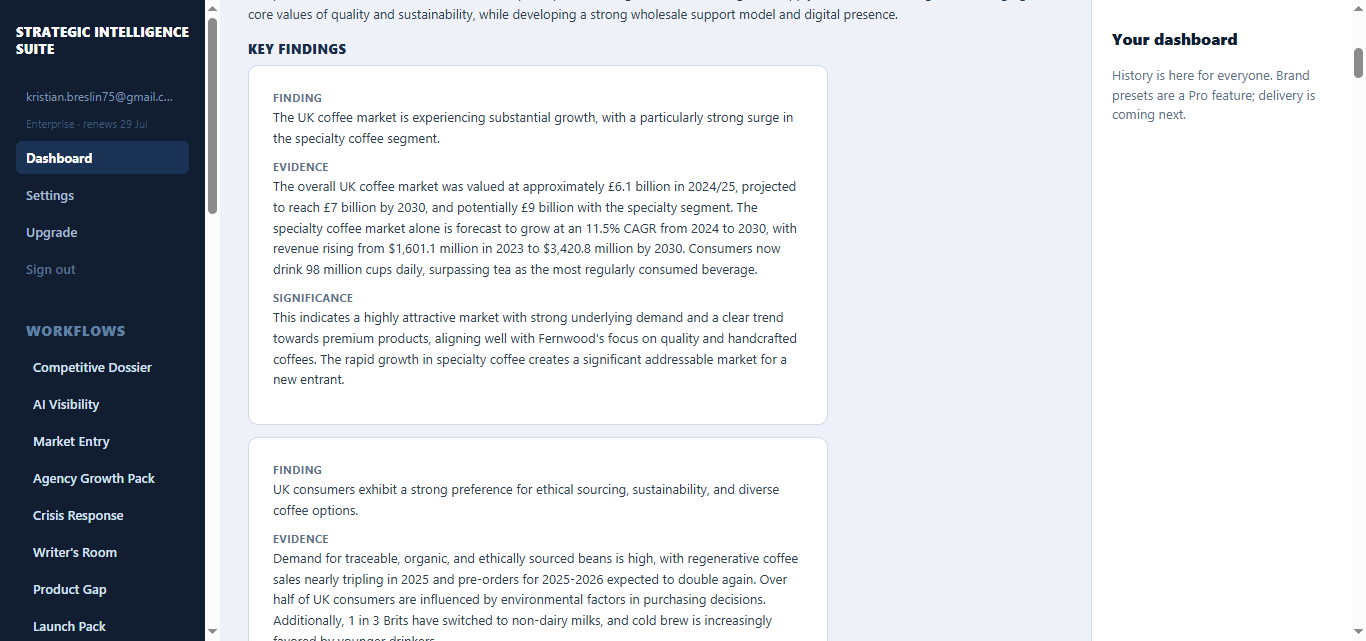
Real screenshots from one actual walk-through — one slide per app in this pipeline.
These slides are one real walk-through, not the whole result
The steps above are captured from one genuine run of this pipeline, demonstrating the "Entering a new country" use case below. Every step's own result feeds into a single composite dossier — synthesised into one verdict, not just the results placed side by side — which you can export as a real PDF at any time from your History. See a real example of that composite PDF dossier →
This is one of 9 chained workflows in the suite, each combining apps from across different groups so one step arms the next — producing a deeper, multi-angle result and more data than running any single app alone.
Market Entry researches a new market, stress-tests it against PESTEL forces, and runs a SWOT on the company entering it — combined into one go/no-go verdict.
Why it works this way
The decision carries through every step
The research step is explicitly grounded against "should [your company] enter [this market]" — not generic market trivia disconnected from the actual call you're weighing.
Calibrated to your actual capital reality
A bootstrapped entrant and an enterprise face genuinely different SWOTs in the same market — declaring your resource scale means the analysis reflects which one you actually are.
One go/no-go verdict, not three separate reports
Research, PESTEL and SWOT are synthesised into a single strategic verdict on the entry decision, not three disconnected analyses you have to weigh up yourself.
Real official UK statistics ground both the research and PESTEL steps whenever the market named is a UK one.
How it works
Entering a new country
- Research Engine: Grounds the target country's market itself — size, recent developments, and the specific question "should we enter?", researched as a real decision rather than a general topic.
- PESTEL Analysis: Stress-tests that country against Political, Economic, Social, Technological, Environmental and Legal forces — the factors that differ most between markets and most often derail a cross-border entry.
- SWOT Analysis: Reads your company specifically against entering that market, carrying your resourcing reality (bootstrapped vs. enterprise) into the read so the verdict isn't generic advice.
The advantage is deciding from outside-in evidence instead of ambition — you walk in already knowing where you stand, rather than discovering it after the money is spent.
Launching into a new vertical
- Research Engine: Grounds the new vertical/segment as its own topic — treating it as unfamiliar territory even if your company already trades elsewhere, so nothing is assumed to carry over.
- PESTEL Analysis: Reads the regulatory and social forces specific to the new vertical — often the exact factors a company moving sideways from an adjacent market gets wrong by assuming it already knows the landscape.
- SWOT Analysis: Judges whether your existing strengths actually transfer to the new vertical, or whether what made you strong in your original market is irrelevant — or even a weakness — in the new one.
The advantage is guarding against false confidence — knowing which of your strengths actually carry over before you bet on the ones that don't.
Testing a new city before wider rollout
- Research Engine: Grounds the specific city or local area — useful for a services or local-presence business testing one location before a wider regional rollout, where national-level research would miss what actually matters locally.
- PESTEL Analysis: Reads local-level factors (local policy, local economic conditions) rather than treating the whole country as one uniform market — the resolution a single-city test actually needs.
- SWOT Analysis: Weighs your company against that one local market specifically, so the verdict reflects the reality of a single-location test, not a national launch you're not actually planning yet.
The advantage is right-sizing your commitment — proof at the scale of a single test, before deciding whether wider rollout is even worth the budget.
Good to know
- Fill in the shared details once at the start — each step arrives pre-filled from them, but every field stays editable before you run it.
- Steps run in order because each one builds on the last — Research grounds the market, PESTEL stress-tests it, then SWOT reads your company against both.
- The final composite dossier is more than the three results side by side — it's a genuine synthesis into one go/no-go verdict.
Delivery integrations
Export any result as PDF, Word, HTML, Markdown, or plain text, and send it directly via Email, Telegram, Slack, Discord, Zapier, Make, n8n.
Pricing
Included in the Pro plan — Pro £19.99/month unlocks this workflow and every app and workflow in the suite at this tier, plus a bring-your-own-API-key option. Not a separate charge per workflow. No free tier.